
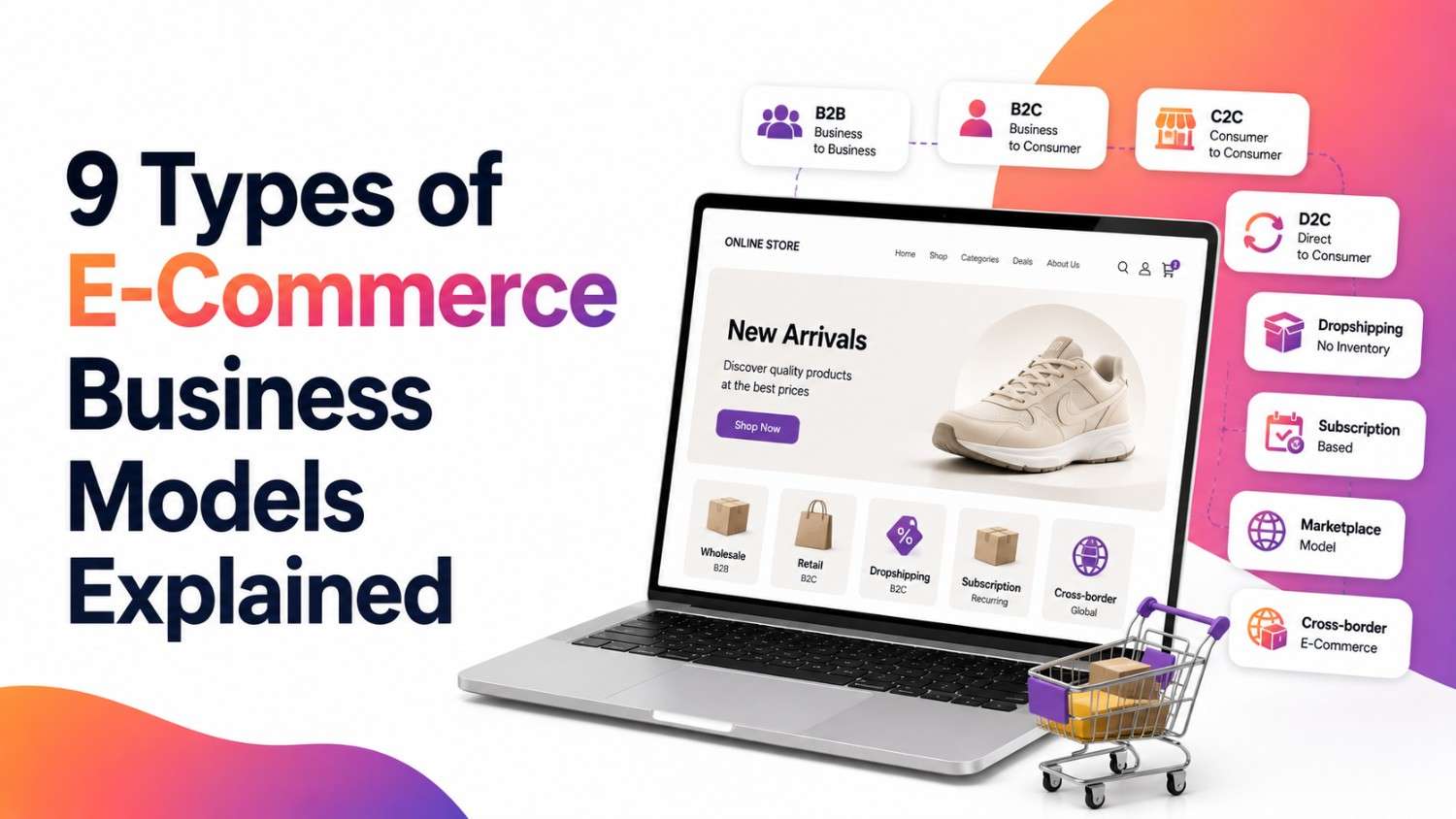
Quick answer: There are nine core e-commerce business models: B2C (business to consumer), B2B (business to business), C2C (consumer to consumer), C2B (consumer to business), DTC (direct to consumer), B2G (business to government), B2B2C (business to business to consumer), and the subscription model. Most successful online businesses actually combine more than one — for example, a DTC brand that also sells wholesale (B2B) to retailers. The right model depends on who your customer is, how you want to control the buying experience, and whether you need recurring or one-time revenue.
Online shopping didn’t just grow after 2020 — it fundamentally changed who sells to whom, and how. A freelance designer selling logo templates on Etsy, a mattress startup shipping straight from its own warehouse, and a wholesaler running an online B2B catalog are all “e-commerce.” Still, they’re running completely different business models with different costs, risks, and growth paths.
Picking the wrong one — or not realizing you’re accidentally running two at once — is a common reason new online businesses struggle with margins or growth. Here’s a clear breakdown of each model, when it fits, and where it falls short.
Quick Comparison: All 9 E-Commerce Business Models
| Model | Who Sells to Whom | Best For | Example |
| B2C | Business → Individual consumer | Retail brands with broad appeal | Amazon, Zara |
| B2B | Business → Business | Wholesale, bulk goods, enterprise software | Office suppliers, software vendors |
| C2C | Consumer → Consumer | Reselling used or handmade goods | eBay, Facebook Marketplace |
| C2B | Consumer → Business | Freelance/specialized services | Upwork, Fiverr |
| DTC | Brand → Consumer (no intermediary) | Brands wanting full control of pricing & experience | Warby Parker, Dollar Shave Club |
| B2G | Business → Government | Regulated, contract-based selling | Office supply/equipment vendors |
| B2B2C | Business → Business → Consumer | Brands using a partner’s distribution reach | Manufacturer → retailer → shopper |
| Subscription | Recurring access model (any audience) | Predictable, recurring revenue | Streaming services, subscription boxes |
| Hybrid | Combination of the above | Most mature e-commerce businesses eventually | DTC brand also selling B2B wholesale |
B2C — Business to Consumer
B2C is the model most people picture when they think of online shopping: a company sells directly to individual buyers through a website or app. It covers everything from clothing and electronics to groceries and beauty products. Platforms like Shopify development make it straightforward to launch and scale a B2C storefront without building infrastructure from scratch.
Why it works: it removes geographic limits on who a retailer can reach, and it’s the most familiar shopping experience for consumers, which lowers the trust barrier at checkout.
Where it struggles: B2C is often the most competitive space in any given niche, since low barriers to entry mean margins get squeezed by larger players who can outspend on ads and shipping.
Examples: Amazon, Walmart, Zara.
B2B — Business to Business
In a B2B model, the customer is another company, not an individual. Purchases tend to be larger in volume and value, and buyers usually expect bulk pricing, custom quotes, and integration with their own procurement or ERP systems.
Why it works: larger order sizes and longer customer relationships mean B2B businesses often see higher lifetime value per customer than B2C, even with fewer total customers.
Where it struggles: sales cycles are longer, and B2B buyers usually need direct sales support rather than a self-serve checkout — which raises the cost of acquiring each customer. Integrating with a buyer’s procurement or ERP system often requires custom software development rather than off-the-shelf tools.
Examples: wholesale suppliers, office equipment vendors, enterprise software providers.
C2C — Consumer to Consumer
C2C platforms let individuals sell directly to other individuals, usually through a marketplace that handles listings, payments, and sometimes shipping. It’s the backbone of resale and secondhand commerce.
Why it works: sellers can monetize items they’d otherwise throw away or donate, and buyers get access to lower prices than retail.
Where it struggles: trust and quality control are harder to guarantee than in B2C, since the platform isn’t the one making or sourcing the product — disputes and fraud are a bigger operational challenge.
Examples: eBay, Craigslist, Facebook Marketplace.
C2B — Consumer to Business
C2B flips the usual direction: individuals offer their skills, services, or content to businesses. Freelance platforms are the clearest example — a designer, writer, or developer lists their services, and companies hire them project by project.
Why it works: it gives businesses flexible, on-demand access to specialized skills without the overhead of full-time hires.
Where it struggles: income for individuals on these platforms is often inconsistent, and platform fees can take a meaningful cut of earnings.
Examples: Upwork, Freelancer, Fiverr.
DTC — Direct to Consumer
DTC brands sell exclusively through their own website, cutting out wholesalers, distributors, and third-party retailers entirely. It’s easy to confuse with B2C, but the distinction matters: B2C can still involve intermediaries (a retailer selling another company’s product); DTC means the brand controls the entire sales channel itself.
Why it works: full control over pricing, branding, and customer data — no retailer taking a margin cut or dictating how the product is presented.
Where it struggles: the brand also owns 100% of the customer acquisition cost, with no existing retail foot traffic to lean on — marketing spend has to do all the work. A well-planned e-commerce development strategy can offset this by optimizing the on-site conversion funnel from day one.
Examples: Warby Parker, Casper, Dollar Shave Club.
B2G — Business to Government
B2G involves selling products or services to government agencies, typically through a competitive bidding or procurement process. It spans everything from office supplies to infrastructure and defense contracts.
Why it works: government contracts tend to be large, stable, and recurring once secured, offering revenue predictability that’s rare in other models.
Where it struggles: procurement processes are slow, heavily regulated, and require meeting specific compliance requirements before a business can even bid.
B2B2C — Business to Business to Consumer
Here, a business sells to another business, which then resells to the end consumer — with the original business often still retaining brand visibility or fulfillment involvement. A manufacturer selling through a retailer, where the manufacturer’s brand still appears on the packaging, is a classic example.
Why it works: the original business gains access to a partner’s existing distribution and customer base without building that reach itself.
Where it struggles: it means giving up some direct control over how the end customer experiences the brand.
Subscription Model
Rather than a one-time purchase, customers pay a recurring fee — monthly or annual — for ongoing access to a product or service. It spans media (streaming), software (SaaS), and retail (subscription boxes, meal kits).
Why it works: revenue becomes predictable and recurring, and locked-in customers are more likely to keep spending than one-time buyers.
Where it struggles: churn is the central risk — if the perceived value drops, customers can cancel just as easily as they signed up.
Can You Combine Models?
Yes — and most mature e-commerce businesses eventually do. A DTC skincare brand might also sell wholesale to boutiques (B2B), or a subscription box company might add a one-time B2C storefront for non-subscribers. Choosing a “primary” model to start with is about focus, not a permanent constraint.
Conclusion
There’s no single “best” e-commerce model — only the one that fits your product, customer relationship, and growth goals. Most businesses start with one clear model (often B2C or DTC) and add others as they scale. If you’re deciding which model fits your business, our website design and development team can help you plan and build an e-commerce platform suited to your specific model.
Frequently Asked Questions
What’s the difference between B2C and DTC?
B2C simply means selling to individual consumers, which can still happen through third-party retailers or marketplaces. DTC specifically means selling only through the brand’s own channel, with no intermediary involved.
Which e-commerce model is most profitable?
There’s no universally “most profitable” model — B2B often has higher order values but longer sales cycles, while subscription models offer predictable recurring revenue but face ongoing churn risk. Profitability depends more on execution than the model itself.
Can a business use more than one e-commerce model at once?
Yes, this is common. A DTC brand might also sell wholesale (B2B) to retailers, or add a subscription option alongside one-time purchases.
Is dropshipping a separate e-commerce model?
Dropshipping is more of a fulfillment method than a distinct business model — it’s typically used within a B2C or DTC structure, where the seller doesn’t hold inventory and a third party ships directly to the customer.
What’s the easiest e-commerce model to start with?
B2C is generally the most accessible starting point, since consumer marketplaces and platforms (Shopify, Etsy, Amazon) provide built-in audiences and simplified setup compared to B2B’s longer sales cycles or B2G’s procurement requirements.
How do I know which e-commerce model is right for my business?
Consider who your customer is (individual vs. business vs. government), how much control you want over pricing and branding, and whether you need one-time or recurring revenue — the answers to these three questions point toward the right starting model.
Is C2C the same as a marketplace?
Not exactly — C2C describes the transaction type (consumer selling to consumer), while “marketplace” describes the platform structure. Most C2C businesses operate as marketplaces, but marketplaces can also support B2C or B2B transactions.
What’s an example of a B2B2C business?
A manufacturer that sells its products through a retailer, while still maintaining its own brand visibility on the packaging and sometimes its own customer support, is a common B2B2C setup