
Ecommerce Development Services
Custom Online Stores Built to Convert, Scale, and Rank
My Virtual Teams is a trusted eCommerce development company. We build online stores that attract customers and build loyalty, increasing visibility and boosting sales. Our expert guidance ensures your eCommerce platform is optimized for growth and long-term success.
Tell Us About Your Project









Ecommerce Development Services We Provide
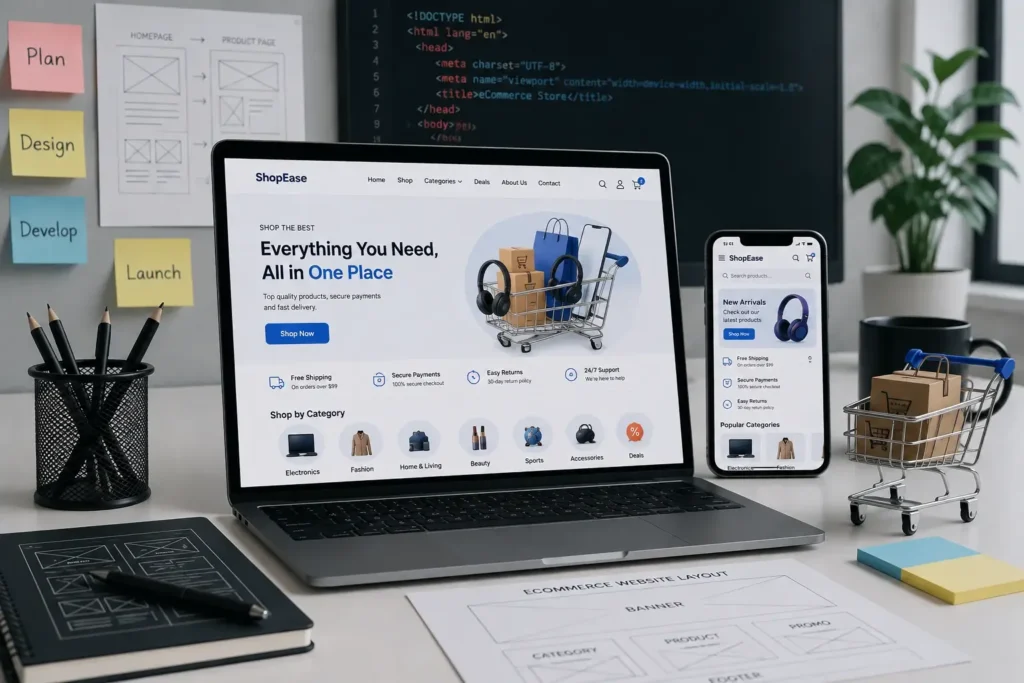
Our ecommerce development services cover everything from custom storefront development and platform migration to integrations, B2B commerce, UX, and ecommerce consulting.
1. Custom Ecommerce Website Development
We build stores from the ground up, not by skinning a theme and calling it custom. That means real decisions about your information architecture, your checkout flow, your product data model, and how your catalog will look at 500 SKUs versus 50,000. Fashion, health and wellness, wholesale distribution, and specialty retail each behave differently at checkout, and we design for that instead of forcing every client into one template logic.
2. Ecommerce Platform Migration
Migrations fail quietly — not with a crash, but with lost SEO rankings, broken order history, or a checkout that converts worse than the one you left. We map your existing URL structure, redirect it correctly, migrate historical order and customer data, and QA the new store against your old conversion benchmarks before we call it done. If you’re moving off Magento 1, a legacy custom cart, or an outgrown WooCommerce setup, this is where most of the real rebuild risk lives — and where we spend the most care.
3. Ecommerce API & Third-Party Integrations
Your store doesn’t operate alone — it needs to talk to your ERP, inventory system, CRM, shipping providers, and often a marketplace feed like Amazon or Google Shopping. We build these integrations to fail gracefully and log clearly, so when a sync breaks at 2 am, you find out from a monitoring alert, not from an angry customer email. Common integrations we handle: NetSuite, QuickBooks, Zoho, Klaviyo, ShipStation, and custom REST/GraphQL APIs for internal systems.
4. Custom B2B Ecommerce Development
B2B storefronts aren’t B2C stores with a login wall bolted on. Buyers need customer-specific pricing, net payment terms, bulk reorder tools, approval workflows for multi-person purchases, and quote requests that don’t force them into a standard checkout. We’ve built these on Shopify Plus (B2B), Magento/Adobe Commerce, and BigCommerce B2B Edition, and we scope this work differently from a standard storefront build because the buying logic is fundamentally different.
5. Ecommerce Theme & UX Development
A theme is the layer customers actually touch, so we treat it as a conversion problem, not just a design one. That means testing checkout on real mobile devices, keeping page weight down so product pages don’t bleed conversions to load time, and building theme code that your team — or ours — can actually maintain a year from now without untangling spaghetti Liquid or PHP.
6. Ecommerce Consulting & Platform Strategy
Sometimes the right engagement isn’t a build — it’s an honest answer to “should we even be on this platform?” We audit existing stores for performance, security, and platform fit, and we’ll tell you plainly if Shopify Plus makes more sense than a Magento rebuild, or if your current setup just needs targeted fixes instead of a full migration. This is a paid, deliverable-based engagement, not a sales call dressed up as consulting.
Ecommerce Solutions for Different Business Models
B2C Ecommerce Development
We develop user-friendly, high-converting storefronts for brands and retailers selling directly to individual consumers. This includes optimized product discovery through search and filtering, streamlined checkout flows that reduce cart abandonment, secure payment gateway integrations, and catalog management systems that scale cleanly whether you’re listing 200 products or 20,000, without slowing down page load or search performance.
B2B Ecommerce Development
We build ecommerce experiences designed around how business buyers actually purchase — not adapted from consumer checkout flows. This means customer-specific pricing tiers, bulk and repeat ordering tools, self-service account management, multi-step approval workflows for team purchases, formal quote requests, and support for net payment terms — all scoped separately from B2C because the underlying buying logic is fundamentally different.
D2C Ecommerce Development
We create direct-to-consumer storefronts engineered around brand storytelling, customer acquisition, and long-term retention rather than just transactional checkout. This includes subscription and repeat-purchase mechanics, personalized product recommendations, loyalty and retention flows, and a seamless purchasing experience across devices — helping brands that sell straight to their audience build lasting customer relationships instead of one-off sales.
Wholesale Ecommerce Development
We support wholesale buyers and sellers with ecommerce platforms built for bulk transactions rather than single-item retail. This includes volume-based ordering tools, customer-specific and tiered pricing structures, real-time inventory visibility across warehouses, dedicated account management portals, and streamlined reordering workflows — reducing manual order processing and giving wholesale customers the self-service tools they expect.
Marketplace Ecommerce Development
We build multi-seller ecommerce marketplaces that connect independent vendors with shared customers under one platform. This includes seller onboarding and administration tools, product and inventory management across multiple vendors, commission structures and automated payouts, order routing and fulfillment coordination, and unified payment processing — giving marketplace operators the infrastructure to manage complexity at scale without manual intervention.
Subscription Ecommerce Development
We develop recurring-commerce experiences for businesses selling subscription-based products or services, not one-time purchases. This includes flexible subscription plan configuration, automated recurring billing and payment retry logic, customer self-service portals for managing or pausing plans, churn-reduction flows, and account management tools — built to keep recurring revenue predictable and reduce the support burden of manual subscription changes.
Multi-Vendor Ecommerce Development
We create multi-vendor ecommerce platforms where each vendor independently manages their own products, pricing, orders, and fulfillment within a shared storefront. This includes vendor-specific dashboards, independent inventory and pricing control, decentralized order and shipping management, and platform-level oversight tools for administrators — giving vendors autonomy while keeping the overall marketplace experience consistent for end customers.
Hire Experienced Ecommerce Developers
Hire Ecommerce developers, consultants, and specialists on demand for custom store development, theme development, app development, migrations, API integrations, performance optimization, and ongoing support.

Amit Kumar
Sr. UI/UX Developer



Nishant Mohan
Full Stack Developer



Nitesh Tiwari
Senior QA Engineer


Rohit Samal
Backend Developer

Narinderpal Singh
Front End Developer

Ecommerce Technology Stack We Use
Our Ecommerce Success Stories
With 350+ active clients, 4+ years average partnership duration, and a 96% retention rate, our growth is built on trust and results




What Our Clients Say

Our Ecommerce Development Process
From initial planning to launch and ongoing support, our structured ecommerce development process keeps every stage focused, transparent, and aligned with your business goals.

Discovery & Requirements
Understand your business model, products, customers, existing platform, integrations, and technical requirements.

Platform & Solution Planning
Select the appropriate platform, architecture, integrations, and functionality based on your business requirements.

UX/UI & Storefront Development
Design and develop the storefront around usability, mobile experience, accessibility, and conversion goals.

Development & Integrations
Build custom functionality and connect your ecommerce store with the required business systems.

Testing & Quality Assurance
Test functionality, checkout, payments, forms, integrations, mobile responsiveness, accessibility, and performance.

Launch & Support
Deploy the store, monitor the launch, resolve issues, and provide ongoing maintenance and support.
Why Businesses
Work With Us
At My Virtual Teams, we combine ecommerce expertise, technical experience, and a practical approach to deliver scalable solutions that support long-term business growth.
90+
IT Professional
6+
Years of Team Seniority
15+
Years of Expertise
Flexible Engagement Models
Dedicated developers, project-based development, ongoing support, etc., if actually offered.
Full-Cycle Ecommerce Development
Strategy → development → integrations → QA → launch → maintenance.
Multi-Platform Expertise
Shopify, WooCommerce, Magento/Adobe Commerce and BigCommerce.
Integration-Focused Development
Connect ecommerce platforms with ERP, CRM, payment, shipping, marketing, and other business systems.
FAQs About Ecommerce Development
What Is Custom Ecommerce Development?
Custom ecommerce development is the process of building an online store’s architecture, storefront, checkout flow, and integrations around a business’s specific catalog, pricing rules, and operations—rather than adapting the business to a pre-built template. Companies with complex product data, B2B pricing tiers, multi-system integrations, or catalogs that template builders can’t support natively typically use it.
What's included in custom ecommerce development services?
Custom ecommerce development typically includes platform selection, store architecture, custom theme or storefront design, third-party integrations (payments, ERP, CRM, shipping), and post-launch support. At My Virtual Teams, every engagement starts with a scoped proposal, so you know exactly what’s included before development begins.
How is a custom ecommerce development company different from a template or app-based builder?
A custom ecommerce development company builds around your specific catalog, pricing logic, and integrations, rather than fitting your business into a pre-built template’s limitations. Template builders work well for simple stores; custom development becomes worthwhile once you have complex product data, B2B pricing rules, or integrations a template can’t natively support.
Do you offer custom B2B ecommerce development services?
Yes — we build B2B storefronts with customer-specific pricing, bulk ordering, approval workflows, and net payment terms on Shopify Plus, Magento/Adobe Commerce, and BigCommerce B2B Edition. B2B builds are scoped separately from standard B2C stores because the buying logic and user roles differ fundamentally.
How long does ecommerce development take?
A standard custom store build typically takes 6 to 10 weeks from kickoff to launch, depending on catalog size and the number of integrations. Migrations can take longer when you need to preserve historical data, SEO redirects, and multiple integrations accurately.
Can you migrate my store without losing SEO rankings?
Yes — SEO preservation is a required QA step in every migration we run, not an afterthought. This includes 301 redirect mapping, metadata and URL structure carryover, structured data preservation, and post-launch rank monitoring against your pre-migration benchmarks.
Which ecommerce platform is best for my business?
The right platform depends on catalog complexity, B2B requirements, and integration needs — Shopify Plus suits fast-growing D2C and B2B brands that want managed infrastructure, Magento/Adobe Commerce suits highly customized enterprise catalogs, and BigCommerce suits mid-market stores that need built-in B2B features without heavy custom development. Our ecommerce consulting service audits your specific requirements and recommends a platform in writing before any build begins.
What should I look for when choosing an ecommerce development company?
Look for a company that can show real client results with specific metrics (not just logos), a clear process for QA and SEO preservation during migrations, transparent engagement models with defined deliverables, and platform-specific experience relevant to your business — B2B pricing logic and ERP integration work differently across Shopify, Magento, and BigCommerce, so generic “we do ecommerce” experience isn’t the same as platform-specific depth.
Ready to Build an Ecommerce Store That Performs?
Let’s discuss your goals, technology needs, and growth plans.